
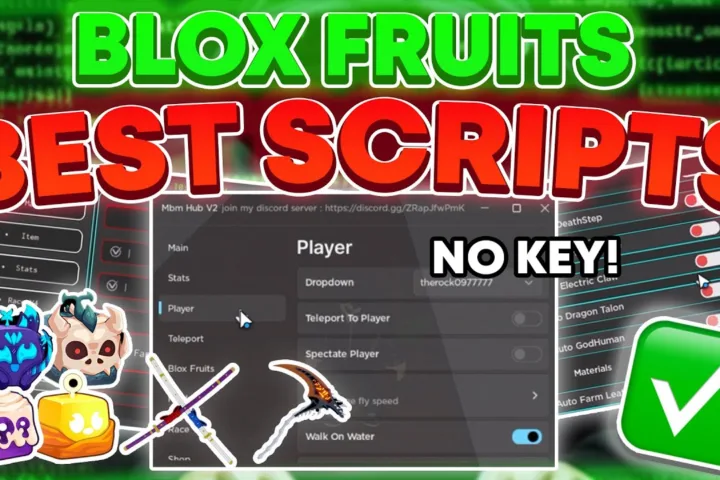
Script Blox Fruits atualizado em 2026 – Fazenda automática de alto desempenho, sem chave e com hub global.
The Ultimate Blox Fruits Scripting Guide for Mobile, PC, and Emulators If you are a fan of epic adventures and the One Piece universe, our Blox Fruits Script is the definitive choice to dominate...
SCRIPT SYSTEM READY
Generate Your Script
Generate Your Script
Preparing script: 20 seconds
Your script is ready. Scroll to the bottom of the page to continue.
- FILE TYPE SCRIPT
- WAIT TIME 20 seconds
- STATUS Ready on finishing
- NEXT STEP Script link
In-depth
The Quiet Machinery of Player-Made Worlds: Lua Scripting in Large-Scale Role-Playing Games
Behind many of the most enduring open-world role-playing experiences lies a technology choice that rarely makes headlines: an embedded scripting language that lets players write their own content. In a genre defined by vast, persistent worlds and long-running communities, extensibility is not a luxury. It is often the difference between a game that fades after its expansion cycle and one that remains alive for decades through the accumulated labor of its player base. Lua, a lightweight scripting language designed for embedding, has become one of the most common foundations for that extensibility, and the way it is deployed reveals a great deal about the engineering constraints of modern game development.
Why Embed a Scripting Language at All
Compiling a full game client is a slow, deliberate process. Every change to core code requires rebuilding, testing, and shipping a new binary. For developers, that loop is manageable. For players who want to add a custom quest tracker, a crafting calculator, or an interface overhaul, it is impossible. An embedded scripting runtime changes the equation. Scripts can be loaded, modified, and reloaded without touching the compiled core, which means the boundary between "game" and "modification" becomes a deliberate design decision rather than an accident of architecture.
Lua in particular was designed for this role. Its interpreter is small, its memory footprint is modest, and its core API surface is compact enough to be exposed to untrusted code with careful sandboxing. A game engine can register specific functions, data structures, and event hooks into the Lua environment, giving script authors a controlled window into the game world without granting them the keys to the whole machine. That controlled window is what makes player-made extensions viable at scale: the developer defines what can be touched, and everything else stays behind the fence.
The Client-Server Divide
Things become considerably more interesting when the game in question is an online world. In a single-player title, a script that manipulates state only has to agree with one authority: the game running on the player's own machine. In a networked role-playing game, state is split between a server that owns the world and clients that render it. Any scripting system must therefore answer a fundamental question before a single line of player code is written: where does this script run, and what is it allowed to know?
The prevailing answer is a split execution model. Scripts running on the client are granted read access to a subset of world state, typically whatever the server has already decided that client needs to see: nearby entities, inventory contents, interface data. Scripts running on the server, where they exist at all, hold broader authority but operate under stricter review, because server-side code can affect every player in the shared world. This split mirrors the broader security principle that the client is never trustworthy. A modification running on a player's machine can be inspected, altered, or wrapped by that player, so any game state it touches must be treated as advisory rather than authoritative.
The practical consequence is that most player-facing scripting is about presentation and convenience, not power. A script can rearrange how information is displayed, automate repetitive interface tasks, or analyze data the client already possesses. It cannot, in a well-designed system, conjure gold, teleport across the map, or alter another player's experience. The enforcement of that boundary is not a moral guarantee but an architectural one: the server validates every consequential action, regardless of what the client-side script claims to have done.
Remote Events and the Grammar of Synchronisation
Connecting the two halves of this system is a messaging layer, and the dominant pattern is the remote event: a named, typed message that travels between client and server. When a player triggers an action, the client script fires an event to the server; when the server changes state, it broadcasts events to the affected clients. This asynchronous message passing is the grammar through which distributed state stays coherent.
Good event design in this context is harder than it looks. Every event crossing the network carries a cost in bandwidth and in validation effort. A well-built scripting runtime therefore treats remote events as a scarce resource: they are rate-limited, size-limited, and schema-checked. A client that fires the same event two hundred times per second is not being creative; it is either buggy or hostile, and the runtime is expected to handle both cases gracefully. Serialization costs matter too. Passing a table of ten thousand entries across a network boundary is a design failure, and mature scripting APIs push authors toward sending identifiers and deltas rather than full state snapshots.
There is also a subtler synchronisation problem: latency. A client script responding to an event is always reacting to a past version of the world. Systems that hide this well tend to rely on prediction and reconciliation, where the client acts immediately on local assumptions and the server later corrects any divergence. Scripting APIs that expose this machinery honestly, allowing authors to distinguish between "what I believe is true" and "what the server has confirmed," produce extensions that feel responsive without lying to their users. APIs that blur the distinction tend to produce extensions that break in confusing ways the moment network conditions degrade.
Performance Budgeting on Constrained Hardware
The third pillar of this architecture is the least glamorous and arguably the most important: performance budgeting. An open-world role-playing game already spends its frame budget heavily, streaming terrain, simulating crowds, and rendering detailed scenes. Every line of player-authored script competes with all of that for the same milliseconds, and unlike core engine code, scripts arrive with no guarantee of quality.
The standard mitigation is a sandboxed execution model with hard limits. Script runtimes can be configured with instruction budgets, memory ceilings, and per-frame time slices, so that a runaway loop or a pathological algorithm degrades gracefully instead of freezing the client. Garbage collection pressure is a particular concern: a script that allocates and discards large tables every frame can trigger collection pauses that manifest as stutter, so well-designed runtimes expose allocation behavior to authors and encourage patterns that keep steady-state allocation near zero.
Budgeting also shapes what the scripting API encourages. Exposing raw per-frame hooks invites authors to poll the world constantly, burning CPU on redundant queries. Exposing event-driven hooks, where scripts are notified only when relevant state changes, aligns player code with the engine's own efficiency. The best scripting environments make the efficient approach the convenient approach, and the difference shows up in frame times across a whole ecosystem of third-party extensions.
Constrained hardware sharpens all of these tradeoffs. Handheld devices, aging PCs, and integrated graphics all share the same reality: headroom is thin. A scripting runtime that consumes a fixed few percent of the frame budget just to exist is a runtime that will eventually be cut. The success of lightweight embeddable languages in this space is largely a story of staying small enough to be affordable even when a world is full of scripts, entities, and network traffic.
The Social Contract of Extensibility
There is a final dimension that is easy to overlook in a purely technical analysis. Every scripting API is also a set of promises. When a game exposes hooks and events to its players, it commits to a degree of stability: scripts written today should not silently break next month. At the same time, the developer reserves the right to evolve the system, which means versioning, deprecation policies, and clear communication become part of the technical architecture rather than an afterthought.
The ecosystems that thrive tend to treat their scripting runtimes as products in their own right, with documentation, tooling, and error messages designed for an audience of enthusiastic amateurs rather than professional engineers. The result is a peculiar and valuable kind of collaboration: thousands of unofficial contributors, working within a sandbox they did not build, extending a world they did not create, all coordinated by an architecture that balances freedom against safety and responsiveness against authority. It is unglamorous infrastructure work, and it is one of the quiet reasons the open-world genre keeps reinventing itself long after the original developers have moved on.