
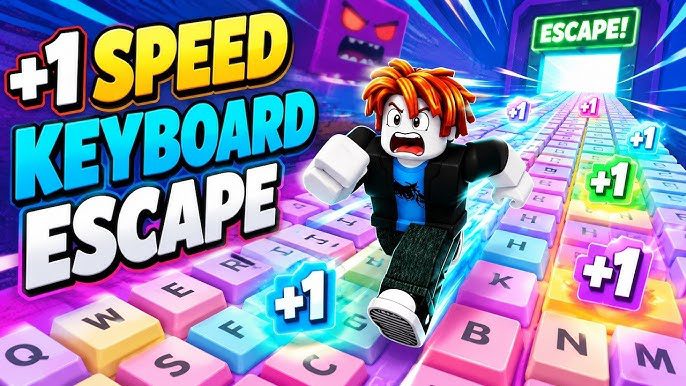
+1 Speed Keyboard Escape Script (2026) – Auto Win, Infinite Speed & Rebirth GUI
Supere os líderes e ultrapasse a concorrência com +1 Speed Keyboard Escape (Roblox) — um simulador de obstáculos incremental e acelerado que combina mecânicas de velocidade de clique, movimentos...
SCRIPT SYSTEM READY
Generate Your Script
Generate Your Script
Preparing script: 20 seconds
Your script is ready. Scroll to the bottom of the page to continue.
- FILE TYPE SCRIPT
- WAIT TIME 20 seconds
- STATUS Ready on finishing
- NEXT STEP Script link
In-depth
The Hidden Clockwork: Why Physics-Driven Games Live and Die by Their Timestep
Obstacle-course games built on physics engines look, from the outside, like simple entertainment. A character tumbles, bounces, and scrambles through a gauntlet of moving platforms, swinging hammers, and collapsing bridges. But underneath the slapstick chaos sits one of the most demanding engineering problems in real-time software: making a physics simulation that is deterministic, stable, and smooth across wildly different hardware. The way developers solve this problem, or fail to, is often the difference between a game that feels fair and one that feels haunted.
What Determinism Actually Means
A physics simulation is deterministic when the same sequence of inputs, applied to the same starting state, always produces the same result. This sounds trivial, but it is surprisingly hard to achieve in practice. Floating-point arithmetic behaves slightly differently across CPU architectures and compiler optimizations. Order of operations in a physics solver can vary depending on how objects are enumerated in memory. Even multithreading can reorder calculations in ways that change which of two nearly simultaneous collisions resolves first.
Why does this matter for obstacle-course games specifically? Because these games are often multiplayer, and many of them use rollback or client-prediction netcode where each machine simulates the world independently. If two players' machines disagree about whether a swinging log knocked a character left or right, the game visibly desyncs. Determinism is not a luxury in this genre; it is a structural requirement.
Fixed Timesteps: The Heartbeat of the Simulation
The foundational technique is the fixed timestep. Rather than stepping the physics simulation once per rendered frame, which varies wildly between a 144 Hz gaming monitor and a throttled mobile device, the engine advances physics in fixed increments, commonly 60 or 120 times per second. The render loop runs at whatever rate the display allows, while the simulation runs on its own metronome.
This design has several consequences. First, it makes the simulation reproducible: step 4,207 of the physics world is always step 4,207, regardless of what the GPU was doing. Second, it stabilizes the numerical integration. Physics integration methods, whether the simple semi-implicit Euler widely used in games or more sophisticated approaches, accumulate error when fed irregular, unpredictable deltas. A character resting on a platform can jitter, tunnel through thin walls during a frame spike, or gain phantom energy. Fixed steps bound that error and make it predictable.
The classic implementation pattern, popularized by an influential article on game timing that circulates in nearly every engine's documentation, uses an accumulator: the engine measures real elapsed time, adds it to an accumulator, and consumes fixed-size slices from it to advance the simulation, looping until the accumulator is drained. Leftover time is carried into the next frame. This decouples simulation quality from frame rate and prevents the notorious "spiral of death," where a slow machine takes longer to simulate, which makes it slower still, until the game grinds to a halt.
Collision Resolution: Where Fairness Is Decided
Fixed timesteps are only half the story. What happens inside each step, particularly collision resolution, determines whether an obstacle course feels consistent or arbitrary. Physics engines typically resolve collisions in two phases: broad phase, which cheaply culls pairs of objects that cannot possibly be touching, and narrow phase, which computes precise contact points and generates impulses to separate overlapping bodies.
Obstacle courses stress these systems in unusual ways. Moving platforms are kinematic bodies, driven directly by animation rather than forces, and they interact with dynamic characters through solver constraints that must be ordered carefully. A character standing on a rotating platform is really standing on a constraint, and if the solver processes constraints in a different order from one run to the next, the character drifts. Deterministic engines impose strict ordering: bodies are sorted by stable identifiers, solvers iterate a fixed number of times, and any randomness in the system is seeded and synchronized across clients.
Then there is the tunneling problem. A fast-moving character, or a fast-moving hammer, can pass entirely through a thin obstacle between two steps. Continuous collision detection addresses this by sweeping objects along their velocity vectors and finding the exact moment of impact, but it is expensive, and many engines apply it selectively. The design of an obstacle course is therefore partly a negotiation with the physics engine: level designers learn to avoid razor-thin colliders, to keep relative speeds within the solver's comfort zone, and to shape geometry so that marginal collisions resolve in visually plausible ways.
There is also a subtler fairness issue: solver behavior at rest. A character wedged between two moving obstacles is in a state the solver resolves iteratively, and tiny numerical differences can produce large visible outcomes, launching the character in one direction on one machine and another direction elsewhere. Games in this genre frequently clamp velocities, snap characters to surfaces within a threshold, and apply other stabilizing heuristics precisely to keep the comedy of failure from becoming the frustration of randomness.
Interpolation: Hiding the Seams
If the simulation runs at 60 steps per second but the display refreshes at 144, rendering the simulation state directly would produce stutter: some frames would show a new state, others a repeated one. The solution is interpolation. The engine keeps the previous and current simulation states and renders a blend between them, using the leftover accumulator fraction as the blend factor. Visually, everything moves smoothly at the display's native rate; mechanically, everything happens on the fixed clock.
Extrapolation is the alternative, projecting objects forward based on their velocity, but it causes visible corrections when predictions overshoot, so interpolation is the standard choice. For networked obstacle-course games, interpolation takes on a second role: remote players' positions arrive as a stream of timestamped snapshots, and each client renders those remote characters slightly in the past, smoothly interpolated between snapshots. This buffering trades a few milliseconds of perceived latency for the elimination of teleporting, jittering avatars. It is one of the great invisible bargains of networked game design.
The Tick Rate Trade-Off
Tick rate, the frequency at which the authoritative simulation steps, is a constant balancing act. Higher tick rates reduce the granularity of collision events, making fast interactions more accurate and competitive play more precise. They also multiply server CPU cost roughly linearly, since the solver's work scales with the number of steps. A physics-heavy obstacle course with hundreds of dynamic bodies is far more expensive per tick than a static map, which is why these games often run simulation steps at rates that would seem conservative by competitive shooter standards, then compensate with interpolation and prediction on the client.
Determinism adds its own constraints. Some engines restrict the use of platform-specific math functions, avoid certain floating-point optimizations, or even implement fixed-point arithmetic to guarantee bit-identical results across devices. These choices ripple outward, limiting library options and complicating tooling, all in service of a guarantee most players never consciously notice, but immediately feel when it is absent.
Why It Deserves More Attention
Physics-driven obstacle games have become a genuinely popular genre, and their apparent simplicity masks a stack of engineering discipline: fixed timesteps for reproducibility, ordered and deterministic solvers for fairness, continuous collision detection where speed demands it, and interpolation to make all of it look effortless. When a character ricochets off a spinning obstacle in exactly the same way on two continents, that is not luck. It is an accumulator loop, a carefully ordered constraint solver, and a rendering pipeline that hides its own heartbeat. The next time a run ends in a spectacular, absurd tumble that somehow felt fair, it is worth remembering the hidden clockwork that made the absurdity consistent.